How to Track Indian Food Calories Without Going Crazy (Roti, Dal, and Curries)
Traditional food logging apps were built for packaged Western foods. Here is how visual AI is solving the chaotic, non-standardized world of home-cooked Indian meals.
Ajay Rathore
May 20, 2026 • 6 min read
Calorie tracking works, but only if you actually do it. For anyone eating a traditional Indian diet, however, tracking calories usually feels like trying to solve advanced calculus on an empty stomach.
While Western diets feature standard portions like "one slice of pre-packaged bread" or "a 150g grilled chicken breast," a typical Indian home-cooked meal consists of mixed curries, changing roti sizes, multi-ingredient dals, and a generous (but unmeasured) splash of ghee or mustard oil.
1. Why Indian Food is Notoriously Hard to Log
The main hurdle is that **Indian food is cooked, not assembled**.
When you cook a subji or a curry, you are not simply weighing raw ingredients and serving them separately. Multiple vegetables are sauteed in oil or ghee, simmered with aromatic spices, tempered (tadka) with cumin and mustard seeds, and garnished with fresh coriander.
By the time the dish reaches your plate, it is a complex, unified blend. Trying to log "10 grams of onions, 5 grams of ginger, 4 grams of oil, and 80 grams of cauliflower" every single time you eat a portion of Aloo Gobi is a recipe for immediate burnout.
2. The Great Roti/Chapati Calorie Variance
Ask a fitness app how many calories are in "one roti," and you might see answers ranging from 60 to 150 calories. Why is the range so wide?
- Flour Composition: Pure whole wheat, multigrain, or addition of millet flours (bajra, ragi).
- Physical Size: A standard homemade chapati can range from 15g to 45g of dough.
- The Ghee Variable: A single teaspoon of ghee brushed onto a hot roti adds a whopping 45 calories of pure fat. If you eat three rotis a day, that represents an untracked 135-calorie gap!
Without physically placing every single roti on a digital kitchen scale before eating, manual logs are just wild guesses.
3. The Chaos of Thalis and Mixed Curry Plates
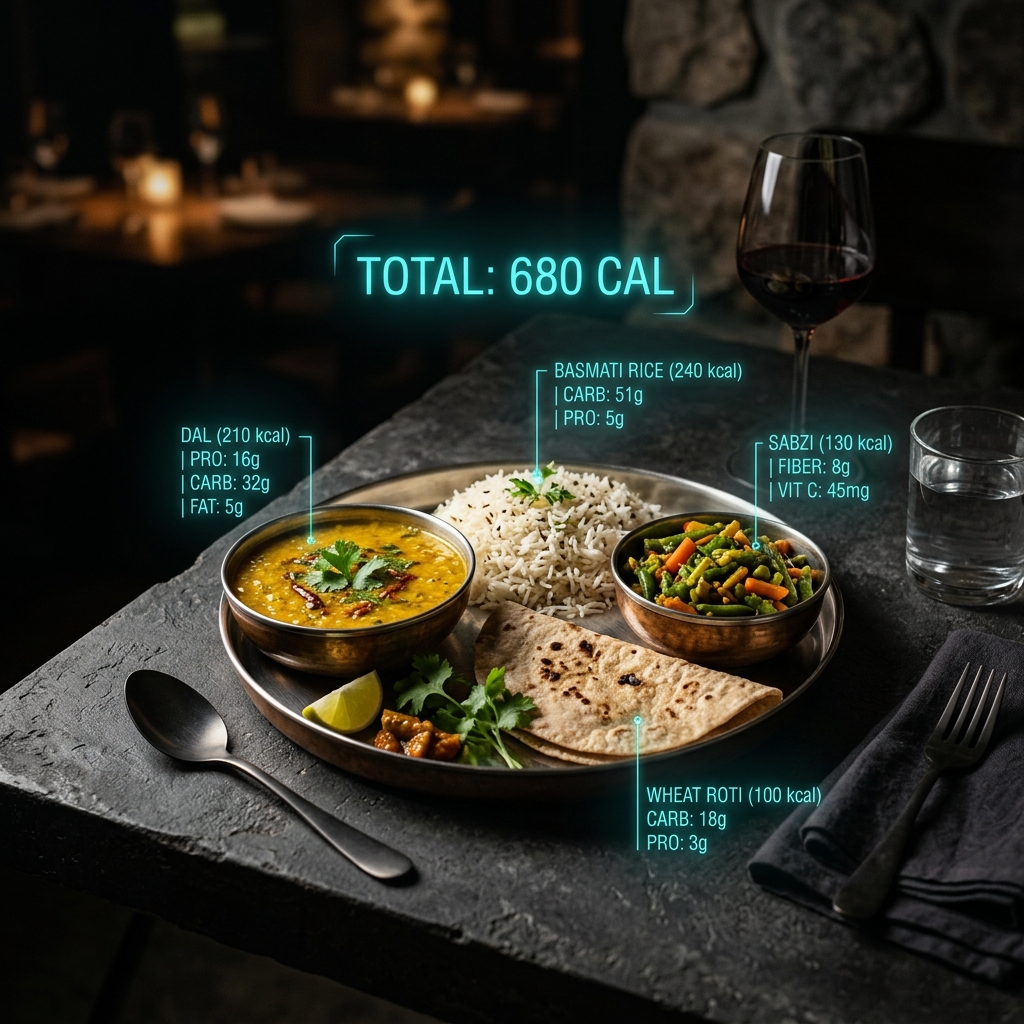
In a traditional thali, you eat multiple items simultaneously: a scoop of dal, a serving of dry vegetable subji, a spoonful of yogurt or raita, rice, and chapatis.
As you eat, these foods mix on the plate. If you forget to log your meal before you start eating, recreating those portion sizes in a traditional database search retrospectively is near impossible. It turns eating into a stressful math homework session.
4. Why Traditional Database Search Fails Indian Diets
Most popular fitness apps feature massive user-generated databases. When you search for "Yellow Dal Tadka," you will get hundreds of conflicting logs:
- "Yellow Dal - 90 kcal" (too low, likely calculated raw)
- "Restaurant Dal Tadka - 280 kcal" (extremely oily)
- "Home cooked dal - 150 kcal" (vague)
Which one is yours? You have no way of knowing. This decision paralysis is highly discouraging and leads directly to dieters quitting their tracking routine entirely.
5. How AI Visual Recognition Solves the Complexity
Instead of searching through messy user databases or breaking a curry down to its raw ingredients, computer vision AI simplifies the entire flow.
Using advanced visual models trained specifically on regional food plates (including diverse Indian dishes), **Nutraize** analyzes a photo of your thali instantly. It identifies:
- The visual boundary and volume of the rice mound.
- The thickness, count, and size of the rotis.
- The depth of the dal bowl to estimate total liquid volume.
- The presence of visible oil glares and fats to adjust macro distribution dynamically.
Friction drops from 10 minutes of tedious manual searching to a simple 3-second photo snap before you eat.
6. Pro-Tips for Perfect Indian Food Logging
To get the most accurate calorie and macro estimation when using a visual tracker like Nutraize, follow these best practices:
- Take the Photo Top-Down: A flat, overhead angle helps the AI volume models clearly measure the surface area and portions of dals, curries, and rotis.
- Keep Bowls Separate: If your curries are in individual bowls (katoris), keep them next to the plate. The AI recognizes standard katori diameters to calculate liquid depth.
- Flag Custom Oils: If you added an extra tablespoon of ghee over your khichdi or roti, you can quickly write a 2-word voice or text note like "+1 tsp ghee" and let the AI adjust the fat macros instantly.
Consistency will always beat extreme precision. An AI visual baseline that you can easily maintain for a whole year is infinitely better than a digital kitchen scale that you get tired of using after 5 days.
Stop Typing and Guessing
Nutraize was built to take the pain out of tracking homemade Indian meals. Snap a picture of your thali, and let our AI calculate your calories and macros in under 3 seconds.
