The "Guesstimate" Tax: How Underestimating Portions Stalls Your Weight Loss
When you choose not to weigh your food and just "eyeball" your portions, you pay a silent tax—in the form of stalled physical progress.

Ajay Rathore
March 1, 2026 • 5 min read
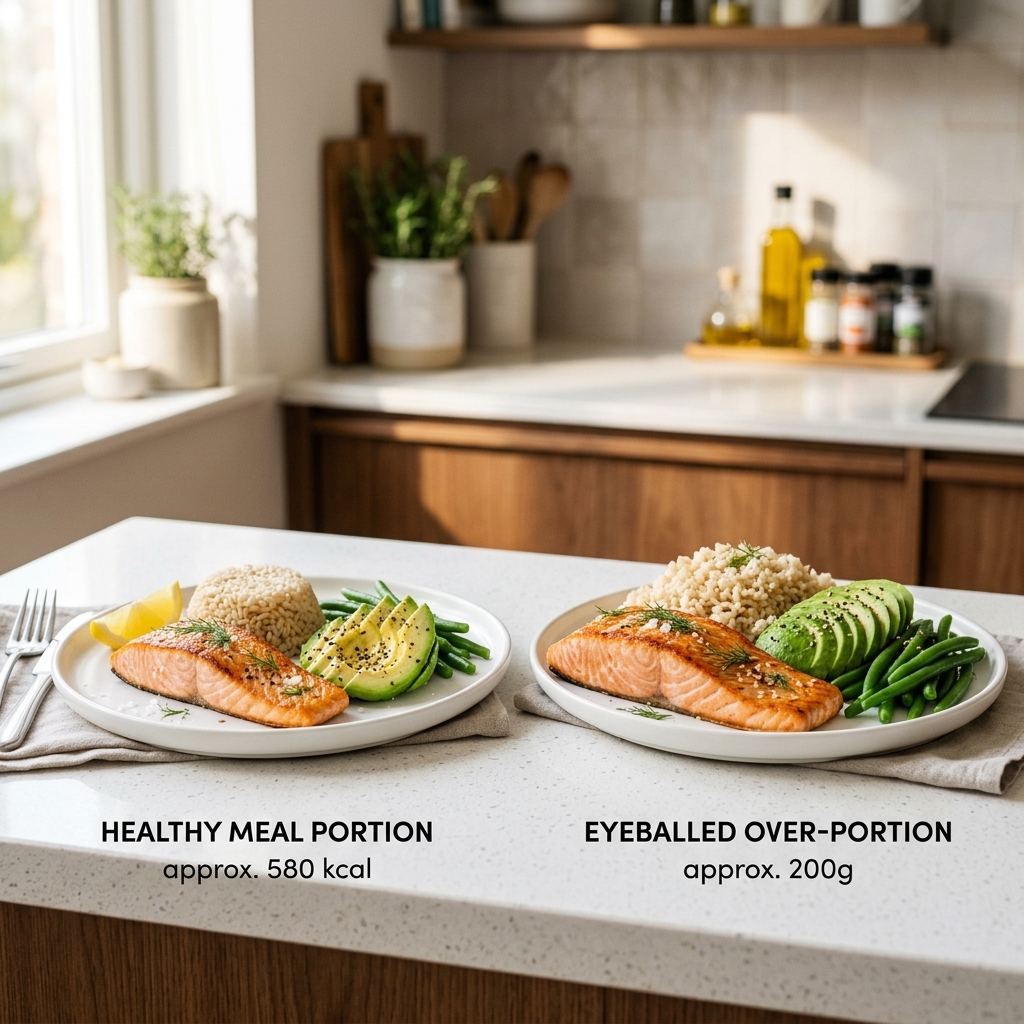
Are you doing everything right but still not losing weight? You've cut back on sugar, you're hit the gym four times a week, and your fitness log says you're eating a perfect 1,700 calories a day.
Yet, the scale refuses to budge. Week after week, the numbers stay exactly the same. You feel frustrated, assuming that your metabolism is broken. But more often than not, the culprit is a silent, invisible leak: the **Guesstimate Tax**.
1. What is the "Guesstimate Tax"?
The Guesstimate Tax is **the calorie discrepancy between what you eyeballed and logged, and what you actually consumed.**
Because weighing food on digital kitchen scales is highly tedious, most people manually "guesstimate" their meals. They eyeball a scoop of rice as "one cup" (200 calories) when it is actually a cup and a half (300 calories). They log a handful of cashews as "10 almonds" (70 calories) when it is actually 180 calories. Over the course of a day, these minor portion underestimations accumulate, adding **300 to 500 secret calories** to your log—completely erasing your weight-loss deficit!
2. The Psychological Blind Spots of Eyeballing
Human eyes are terrible scientific measuring tools because they are highly vulnerable to **psychological bias**.
When we are hungry or craving a high-calorie food, our brains subconsciously downplay portion volume. We scoop a massive mound of peanut butter onto a spoon and convince ourselves it is "just a tablespoon." We ignore the cooking sprays and the small bite-sized samplings we take while cooking. These optical blind spots are completely natural—but they make manual eyeballing highly unreliable.
3. The Delboeuf Illusion: How Plate Sizes Cheat Your Eyes
Our perception of portion size is relative to the size of the tableware we use. This is known in cognitive psychology as the **Delboeuf Illusion**.
If you place a 150g portion of pasta on a massive, oversized restaurant plate, your brain perceives the food as a tiny, meager serving. As a result, you will naturally over-serve yourself or assume the calorie count is low.
Conversely, the same 150g portion placed in a small bowl looks like an enormous, overflowing feast. Because human eyes are constantly tricked by background size references, visual estimations are highly distorted.
4. Photographic Logs: Your Objective Nutrition Baseline
How do we break the guesstimate loop without having to carry a kitchen scale to every dinner table?
By using a photographic feedback loop. Taking a quick photo before eating introduces a small pause, breaking impulsive eating patterns.
More importantly, a photo serves as an **objective record**. It has no ego, no bias, and no hunger. It captures the meal exactly as it is, creating a high-fidelity visual log that you can look back on to calibrate your awareness.
5. Visual AI Portion Calibration
Using visual AI like **Nutraize** completely automates this calibration process.
The visual AI doesn't fall for the Delboeuf Illusion. By analyzing pixel distribution, contours, and physical reference points (like the dimensions of a standard plate or glass), it maps portion sizes using absolute mathematics.
It neutralizes your psychological biases, spots hidden calorie dense regions, and logs your actual portion size automatically. By removing the guesstimate tax, it secures your daily deficit and finally helps you break through long-standing plateaus.
Stop Paying the Guesstimate Tax
Nutraize uses optical math to log your meals objectively. Ditch the guessing game, snap a picture, and keep your calorie tracking completely accurate.
